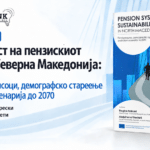

North Macedonia’s pension system is facing structural fiscal pressures that are already present rather than a matter for the distant future. The structural deficit of the Pension and Disability Insurance Fund—defined as pension expenditure, transition costs related to the second pillar and healthcare contributions, less the Fund’s own contribution revenues—reached MKD 54.4 billion, or 5.2% of GDP, in 2025. This means that around 41% of the Fund’s expenditure is covered by the state budget, compared with approximately 36% in 2023.
The deficit results from three forces that have been at work for more than two decades. First, the contribution rate was reduced from 21.2% to 18% in 2009–2010, although it was increased to 19.9% as of 1 July 2025, while pensions were repeatedly raised outside the statutory indexation formula. Second, demographic trends have become increasingly unfavourable: the fertility rate stands at 1.6, natural population growth has been negative since 2019, and since 2021 the number of people aged over 65 has exceeded the number of children. Third, labour-market weaknesses persist: informal employment has risen again to 13.5%, while women remain significantly less economically active than men.
Since 2023, pension expenditure has been growing considerably faster than contribution revenues—by 19% compared with 8.8% in 2025. This is not a demographic effect, but the result of pension indexation and across-the-board increases.
Without reform, the deficit will rise from 5.2% of GDP in 2025 to 6.3% by 2030, reaching a peak of approximately 6.6% in 2035–2037. The most critical period will be 2038–2048, when transition costs peak and the number of insured persons per pensioner falls below 1.3. In the long run, the deficit appears to decline—to 5.5% in 2050 and 2.7% in 2070—but this does not represent a genuine improvement. Pensions will increasingly lag behind wages, with the ratio of the average pension to the average net wage falling from 59% to 35% by 2050. In absolute terms, the deficit will continue to grow throughout the projection period, while by the mid-2040s there will be fewer insured persons than pensioners.
The study shows that no single measure is sufficient. With reform—namely, a combined package comprising a gradual increase in the contribution rate to 20%, inflation-only indexation, higher female labour-market participation and reduced informality—the deficit would fall to 4.2% of GDP by 2030, instead of rising to 6.3%, and to below 0.5% by 2050. A change in the retirement age as part of this package would have only a small additional effect of less than 0.2 percentage points of GDP. The trade-off is a lower replacement rate, measured as the ratio of pensions to net wages. If the current indexation formula is retained, however, the deficit will remain above 4% of GDP until 2040.
Short-term fiscal savings refer to the reduction in budget transfers to the Pension and Disability Insurance Fund during the first ten years of a potential reform, from 2026 to 2035, compared with the no-reform scenario. Under the combined reform package, these savings would amount to approximately MKD 337–341 billion—around €5.5 billion—or a cumulative total of approximately 30% of GDP. On an annual basis, this represents an average of around MKD 34 billion, or approximately €550 million, equivalent to about 3% of GDP. This is three to four times the savings generated by the most effective individual measure—inflation-only indexation—which would save approximately MKD 179 billion, or around €2.9 billion.
Nevertheless, the study highlights a fundamental dilemma between pension-system sustainability and pension adequacy. Under inflation-only indexation, the replacement rate would fall to approximately 22% by 2050, compared with 35% under the current formula, with both figures below the 40% threshold commonly used as a minimum benchmark. The study therefore recommends introducing a guaranteed minimum pension instead of ad hoc pension increases and replacing discretionary decisions with an indexation formula incorporating an automatic fiscal adjustment mechanism.
“Parametric reforms are necessary, but not sufficient—they buy time. The window for reform is closing around 2035, while the cost of delay does not rise linearly but accumulates over time,” Petreski emphasised.
The study was prepared using the PSSM-MK model and is based on official data from the Pension and Disability Insurance Fund of North Macedonia, the State Statistical Office, the Ministry of Finance and international databases.