Finance Think conducted a model-based assessment of the effects of the current geopolitical shock on inflation, based on three scenarios that differ in terms of the intensity and persistence of the energy price shock, as well as the way in which it is transmitted through the economy.
In the baseline scenario, it is assumed that the shock is already partly embedded in current market prices and that there is no further escalation. Energy prices rise in the short term, peaking by the end of the second quarter of 2026, after which they stabilise relatively quickly amid a de-escalation of military activity and begin to decline gradually in the second half of 2026 and throughout 2027. The pass-through to other prices is limited and gradual, without significant second-round effects.
In the adverse scenario, a stronger, yet still time-limited, shock is assumed. Energy prices increase more sharply and reach a higher peak in the third quarter of 2026, while uncertainty and external conditions deteriorate further. In this scenario, the transmission to other prices is more pronounced, including both indirect and second-round effects, but over time the shock begins to recede, with visible normalisation during 2027.
In the extreme scenario, a strong and persistent shock is assumed, associated with prolonged geopolitical escalation and lasting supply disruptions. Energy prices continue to rise and reach their peak toward the end of 2026, in the fourth quarter, after which they remain relatively high for a longer period and begin to decline more slowly during 2027. The transmission through the economy is more intense and broader, which makes inflationary pressures more persistent and more pronounced.
The results of the model-based calculations for North Macedonia show that inflation would rise under all scenarios, but with significant differences in dynamics. In the baseline scenario, the increase in inflation is moderate and short-lived, peaking in mid-2026 and followed by gradual normalisation. In line with this, Finance Think revises its projection for average inflation in 2026 to 3.5%, with pronounced upside risks.
In the adverse scenario, the peak is higher and shifts to the second half of 2026, while the return to lower inflation rates is slower. Under this scenario, 2026 would end with an average inflation rate of 6.1%. In the severe scenario, inflation reaches its highest level toward the end of 2026 and remains elevated throughout 2027, pointing to a more persistent shock. Under this scenario, average inflation in 2026 would amount to 8.2%.
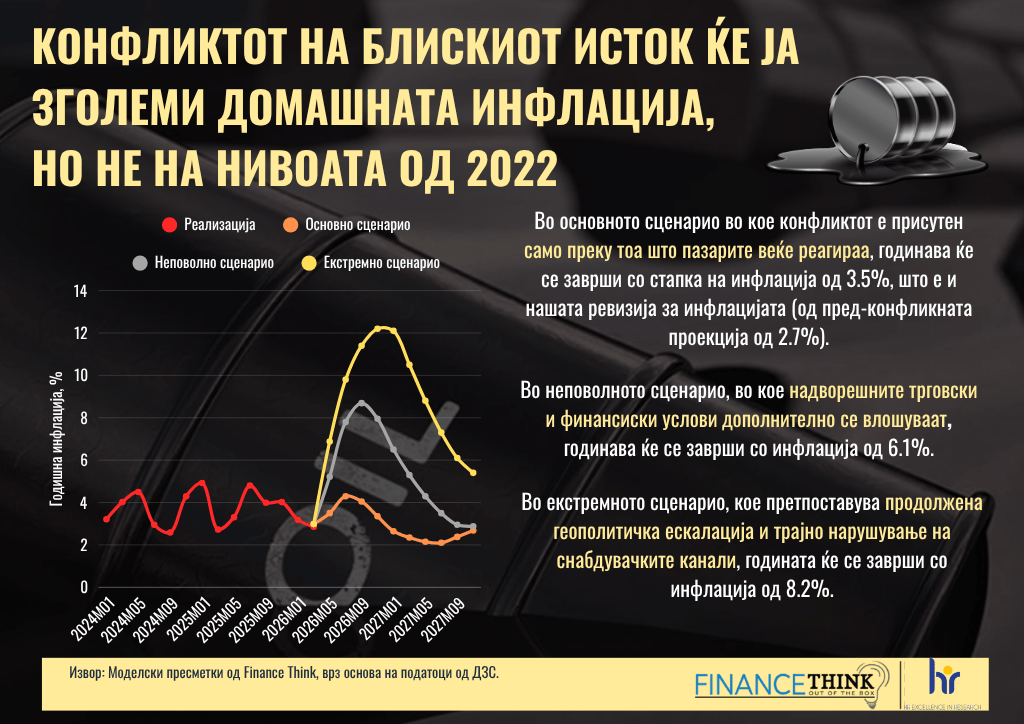
The key conclusion is that the duration of the shock is decisive for its impact on inflation. If energy prices stabilise relatively quickly, inflationary pressures will remain contained. However, if the shock persists, it will generate broader and more prolonged price pressures through higher costs of production, transport, and imports.
Although the risks of higher inflation are real, the results suggest that the most likely outcome is a relatively moderate inflationary wave, rather than a repetition of the price shock experienced in 2022.