Authors: Zoran Sapuric, Sanela Shkrijelj, Blazhe Josifovski
Authors: Zoran Sapuric, Sanela Shkrijelj, Blazhe Josifovski
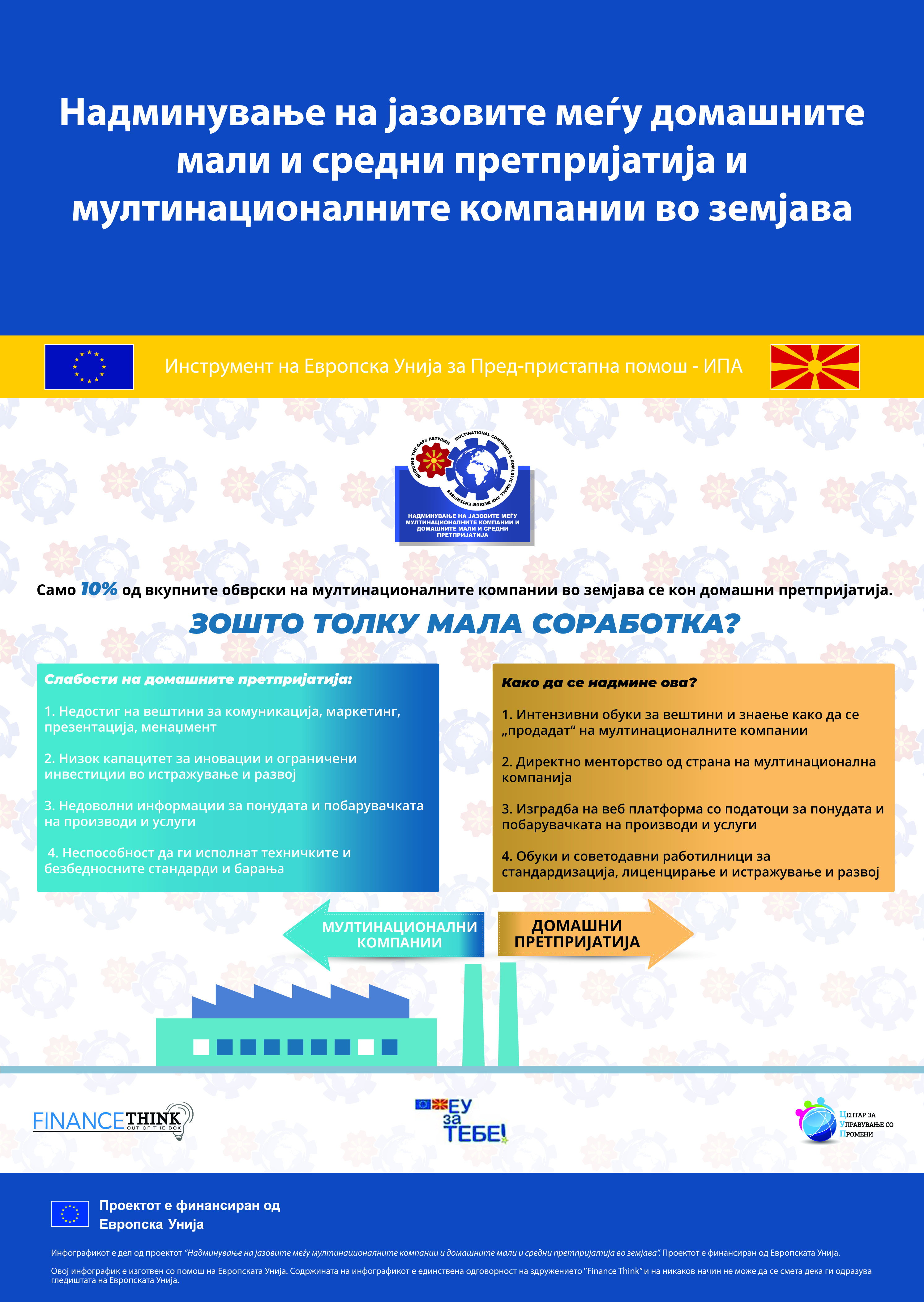
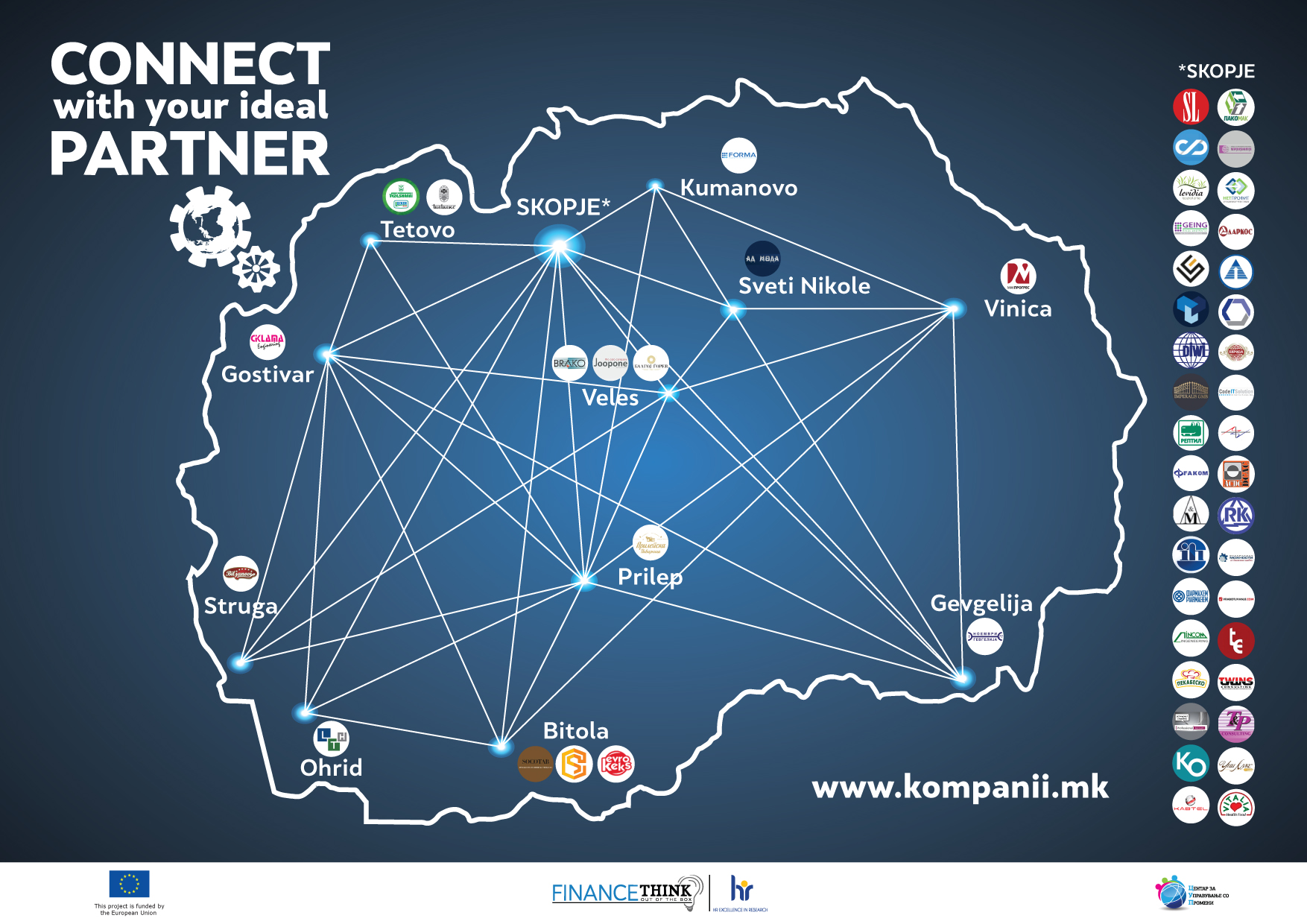
The overall objective of the Action is to establish and/or improve the linkages between domestic SMEs (dSMEs) – multinational companies (MNCs) operating in Macedonia, with the final goal to increase domestic business sector competitiveness.
This overarching aim is broken down into specific objectives:
The project will deliver the following outcomes:
Donor: European Commission (CFCD – Ministry of Finance)
Duration: January 2018 – December 2019
Tenders
Call for tender 02-67/1 – Offer submission request – Offer form
Call for tender 02/230/1 – Offer submission request – Offer form
Call for tender 02/231/1 – Offer submission request – Offer form
Call for tender 02/232/1 – Offer submission request – Offer form
Call for tender 02/229/1 – Offer submission request – Offer form
Call for tender 02/223/1 – Offer submission request – Offer form – Specifications
Call for tender 02/222/1 – Offer submission request
Call for tender 02/316/1 – Offer submission request – Offer form
Call for tender 02/88/01 – Offer submission request – Offer form – Specifications
Call for tender 02/404/01 – Offer submission request – Offer form
Documents:
Training manual for soft skills
Visual products
Leaflet 1 – Leaflet 2 – Leaflet 3
Other visual products here
This Project intends to initiate policy platform dealing with the welfare state issues to strengthen cohesion, stability and growth in the Western Balkans and its sustainable European perspectives.
The specific objective is to support effective regional advocacy on issues of critical importance for the welfare state area, through long-term regional cooperation and learning from EU experience, as preconditions for inclusive evidence-based policy making.
Duration: January – December 2018
Donor: European Fund for the Balkans
Project partners: Center for Social Policy – Belgrade, Qendra Economic Social Analytics – Tirana
The objective of the project is to provide background calculations in Stata to feed the preparation of two studies: Country Diagnostics and Public Finance Study by the world bank, based on data from LFS, SILC and HBS.
Donor: The World Bank
Duration: December 2017 – June 2018

Authors: Marjan Petreski, Nikica Mojsoska-Blazevski
The overall goal of the project is an ex-post assessment of the impact of the changes in the Minimum Wage Act on the system (the economy) and the main stakeholders (workers and employers).
The specific objectives of the project are:
Duration: January – December 2018
Donor: Institute for Democracy “Societas Civilis” – Skopje

Authors: Maja Parnardzieva-Zmejkova, Vladimir Dimkovski

Authors: Ana Mickovska-Raleva, Ana Tomovska-Misoska, Olimpija Hristovska-Zaeva, Suzana Cerepnalkovska, Vesna Kostik Ivanovik

Authors: Blagica Petreski, Nikica Mojsoska-Blazevski
The objective of the study is to describe underemployment and investigate its effect on personal wellbeing in the three countries. Special reference to gender will be made. By so doing, it opts to bring the issue to policymakers’ agenda and formulate ideas for policies tackling underemployment.
Methodologically, we first set underemployment a function of personal and local-labor-market characteristics. We rely on Heckman models – binary- and ordered-outcome ones – to overcome the potential selectivity bias into underemployment. For the ordered case, we use a CMP estimator. We then regress personal welfare on underemployment and worker’s characteristics. As welfare is latent variable, we rely on MIMIC model. To overcome potential endogeneity of underemployment, we specify third regression in the model whereby observables and exogenous instrument determine underemployment. The average local/municipal wage at the time when the person became (under)employed is used as instrument.
The School to Work Transition Surveys (2014-2015) are used.
Donor: Partnership for Economic Policies
Duration: 2017-2019