The overall objective of the project is to further strengthen the organizational capacity of the Economic Research & Policy Institute “Finance Think” in supporting the economic policy decision makers to deliver credible policy decisions based on research findings, as well in igniting the debate in the society about economic processes and reforms.
Provider: Think Tank Fund (Open Society Foundations)
The objective of the project is to address efficiency and quality of selected policies in quality of life, education and health through public debate and policy options derived from data and evidence.
The project is expected to bring the following changes:
Changed general understanding of the importance of specific policies and measures within the QEH areas
Increased availability of data in the specific areas set base for evidence-based policymaking
Steered public debate and increased public awareness about the issues
Increased pressure on policymakers for better and more efficient public policies and measures in the QEH areas
Improved research capacity, networking and sharing of expertise
The project will deliver the following outputs:
Mapping and selection of policies per year in three areas (QEH)
Research and production of results
Links with media outlets and development of outreach products (comms strategy)
Capacity building for teams and media for use of data, cost benefit analysis and policy options
The project aims to forecast the size and effects of remittances and emigration in 4 Western-Balkan (WB) countries, through a novel method: Delphi questionnaire.
In particular, the project has the following tasks: 1) to provide a literature overview of forecasting remittances and emigration; 2) to collect data through a Delphi questionnaire from economic experts and remittance-receivers; 3) to forecast remittances and emigration based on the data obtained in (2); 4) provide policy recommendations based on the forecasted trends; and 5) to compare forecasted trends among the 4 countries.
Donor: Regional Research Promotion Program
Project partners: ACSER Albania, FREN Serbia, Individual researcher Kosovo
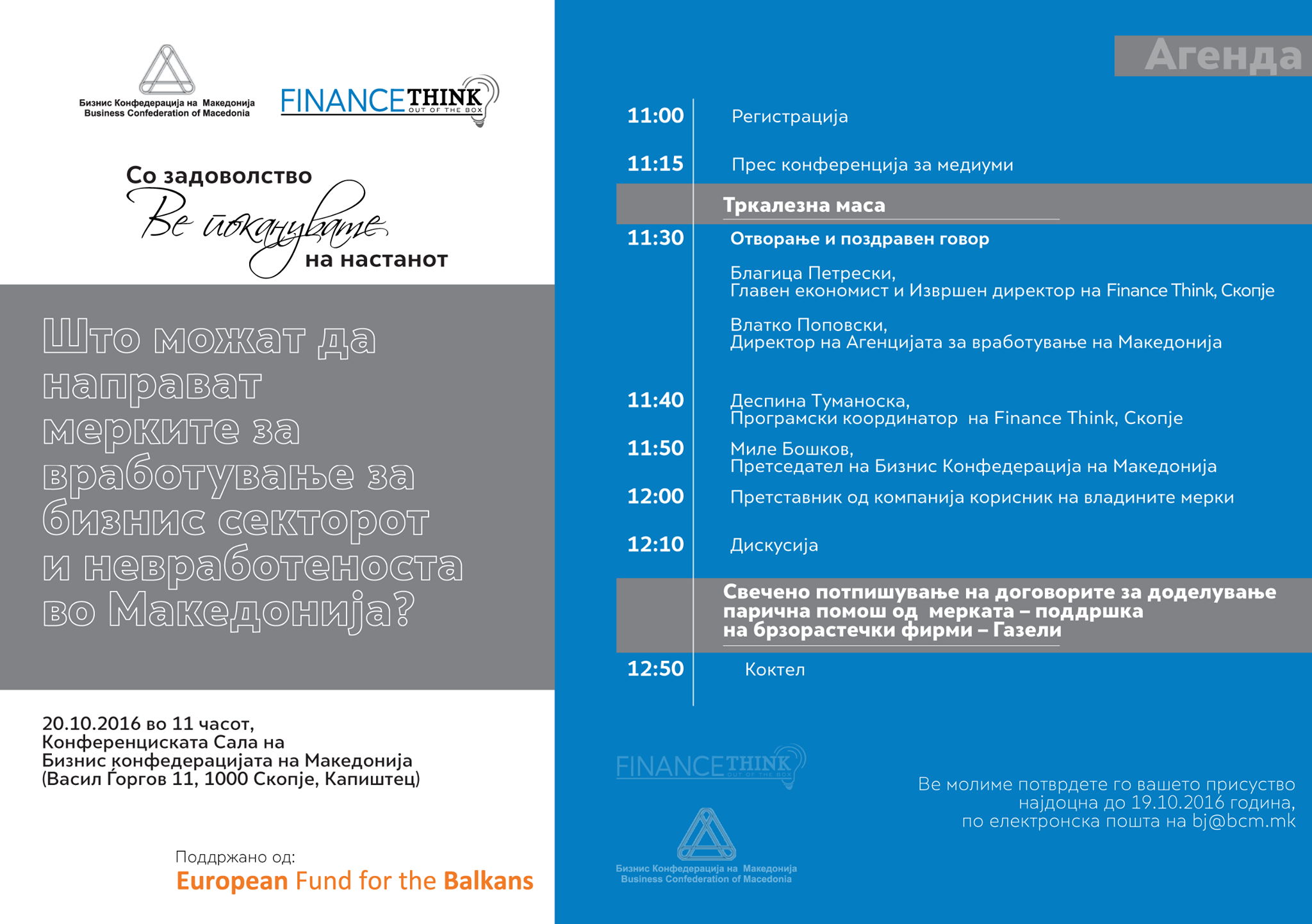
Round table “The future of remittances and emigration: Can they be forecast?”, 22 November 2016, Faculty of Economics, Prilep – Invitation and agenda – Gallery
The main objective of the project is to contribute to improvement of active labour market policies and boosting employment in Albania, Bosnia and Herzegovina and Macedonia.
More specific objectives of the policy advocacy are: (a) to identify legal, financial, and practical weakness in employment policies which result in their low efficiency and low effectiveness; (b) to inform and expand knowledge of key stakeholders in the field; (c) to empower stakeholders to make informed decisions by providing relevant analysis and feasible policy recommendations in this area; and (d) to put the issue of ALMP on the respective agendas of relevant decision-makers in these three countries.
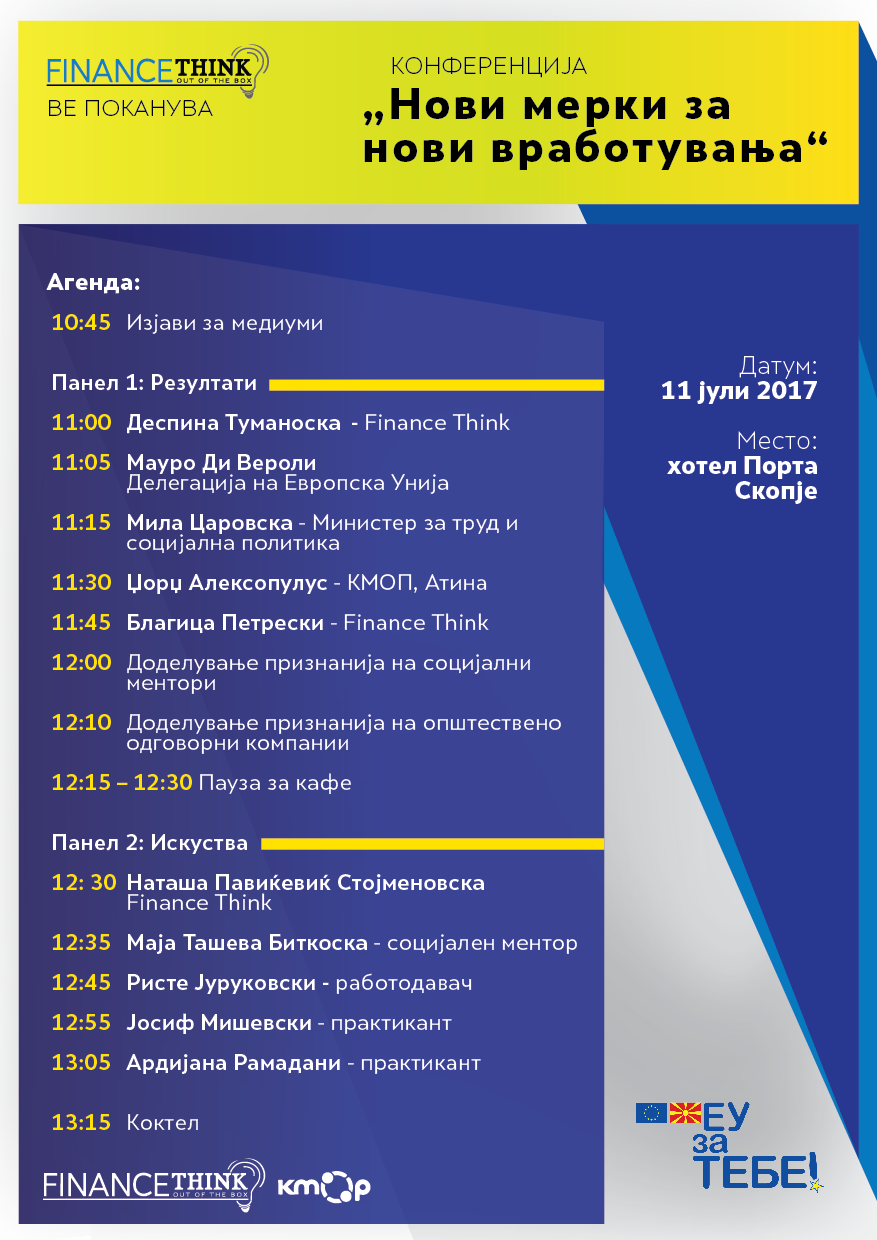
Overall objective of the project is to increase the activation of persons at risk of social exclusion in the labor market by improving their skills, education, qualification and facilitating their full integration into the society and the labor market.
This overarching objective is broken down into specific purposes involving concrete interventions on three fronts:
Purpose 1: Improve the efficiency of employment and social services as a way of promoting the social inclusion of vulnerable and disadvantaged groups by assisting professionals from the Employment Centres and the Centres for Social Work in developing new skills as ‘Mentors for Social Inclusion’;
Purpose 2: Empower vulnerable and disadvantaged groups and give them the skills and experience required to breaking down the hurdles they encounter on their journeys into long-term work and independence through a pre-employment training program and work placements or internships in local businesses and social enterprises;
Purpose 3: Foster improvements in service delivery by designing new family support services, raising public awareness, and developing effective partnerships among key
stakeholders (local self-government units, governmental institutions, non-governmental organizations involved in service delivery, social partners, education and training providers) to produce results on the ground.
Donor: European Commission – Instrument for Pre-Accession Assistance
Partner: Childcare and Family Center (KMOP) – Athens, Greece
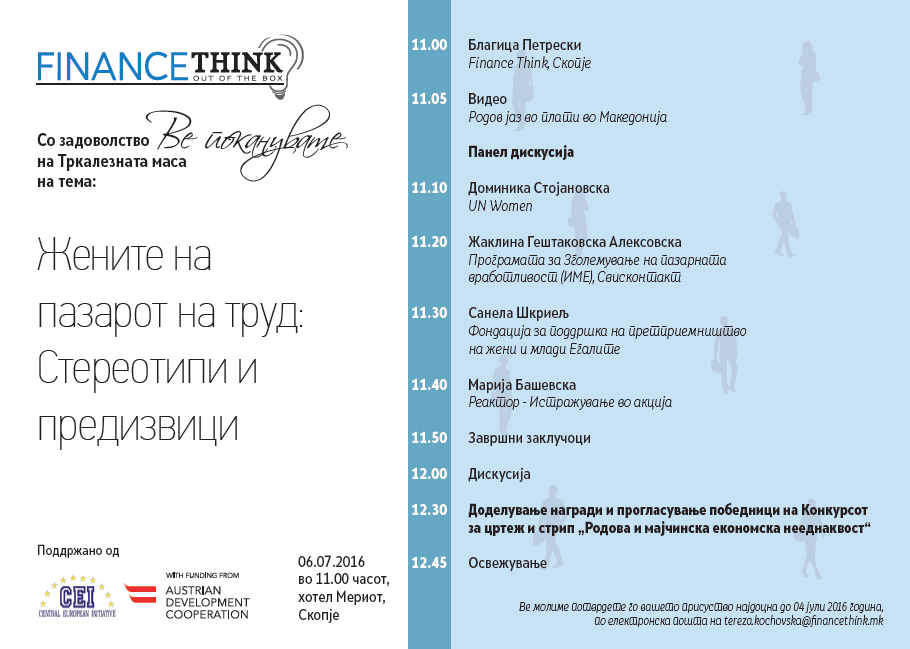
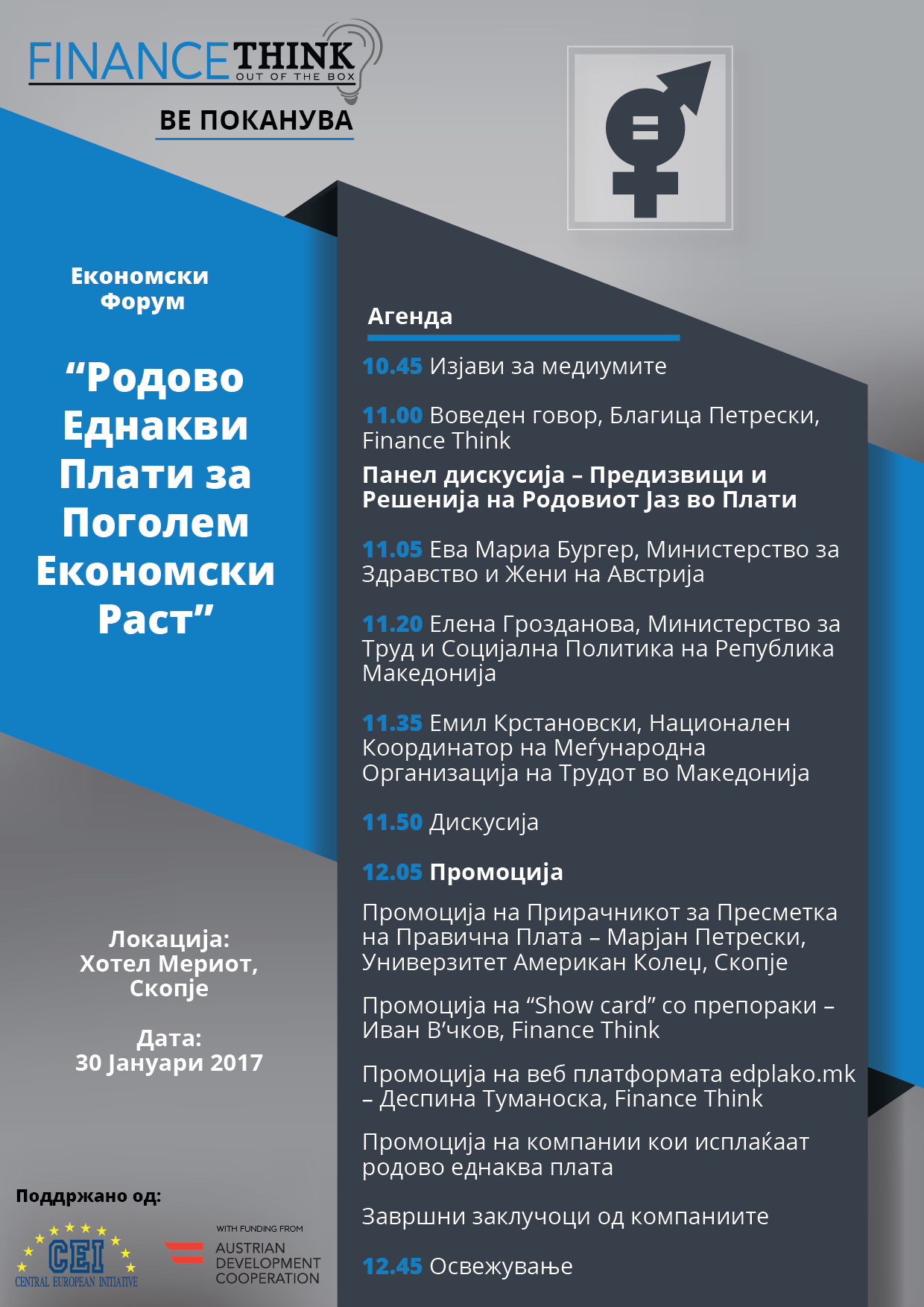
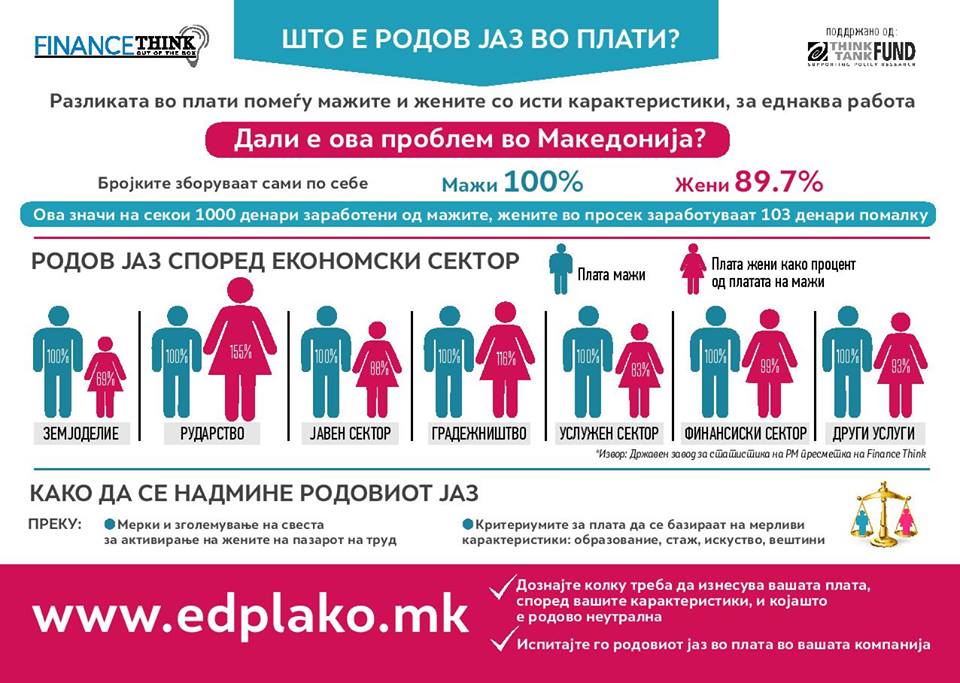
The objective of this project is to correctly measure gender pay gaps (difference in wages between men and women) and motherhood pay gaps (difference in wages between mothers and childless women) in Macedonia and to advocate solutions for addressing the prevalent pay gaps.
In particular, previous research has demonstrated that Macedonia faces gender and motherhood wage gaps of 12.5% and 8.7%, respectively. However, a large part of females remains outside the labour market and can therefore not be considered when the pay gap is calculated (as their wage is not observed). This makes the above figures incorrect, since it is likely that females who stay outside the labour market are not randomly selected not to work. Hence, one bold challenge is to obtain knowledge for the proper calculation of pay gaps, i.e. econometric (technical) knowledge to address the selectivity bias in the labour market.
The project envisages activities positioned within three pillars:
Professional development thorough capacity building and direct knowledge transfer.
Collaborative research.
Building networks for advocacy, promotion and collaboration beyond the project cycle.
Donor: Know-how Exchange Program – Austria through the Central European Initiative
Project partner (know-how provider): The Vienna Institute for International Economic Studies
Duration: November 2015 – January 2017
***
Video – The gender wage gap in Macedonia through the perspectives of 5 women
Innovation persistence and firm growth models, Dario Guarashio, University of Rome Sapientsa, 19 September 2016
On the future of the European Monetary Union: Targeted reforms instead of greater fiscal integration” Ana Iara, European Commission, 20 September 2016
The space for an industrial policy in Europe, Mario Pianta, 22 September 2016
Modest recovery in the East – new uncertainty because of Brexit, the economic relations of Austria with the region and the long-term structural changes in the CESEE countries, Mario Holzner, 23 September 2016
Connectivity in Central Asia – International workshop, 15-16 December 2016.
Working meeting with a gender expert at the Vienna University of Economics and Business, Vienna, 22 September 2016 – Gallery
Research stay, Vienna, 14-15 December 2016 – Agenda
The overall objective of the project is twofold: first, to improve the capacity of civil society and media to contribute to evidence-based economic dialogue in the country, enabling more participatory and transparent policymaking, with strong focus on fiscal policymaking; and, second, to increase the public awareness for the process of spending public money.
The objective of this project is to raise the awareness for the gender wage discrimination in Macedonia.
In particular, the project builds on an ongoing work, consisting of two pillars: i) calculating the gender wage gap in Macedonia, after workers’ characteristics and selectivity bias have been taken into consideration; and ii) building the EdPlaKo-MK web tool which enables individuals to test their gender-neutral wage and companies to test their wage system against gender discrimination. The main activity of this proposal consists of visualization of the gender wage gap in Macedonia that will be added to the EdPlaKo-MK site, as well through two flyers, so as it gives further information on gender wage gap at the level of sector, occupation, age, experience and education, and further promotes the EdPlaKo-MK tool.
The main objective of the project is to improve self-sustainability of women through development of alternative touristic attractions out of their skills for traditional, homemade and ecological production: embroider linen, knittings, wild berry jams, pasta peeling and grains, natural tea and the like.
Project activities envisage: training of Krushevo women for skills for entrepreneurship, promotion and sales of traditional products, expanding and strengthening the mini-cluster developed within the previous project, developing of three alternative touristic attractions embedding traditional values and promotional campaign involving an event “Days of alternative touristic attractions in Krushevo” and the Fair “It’s homemade, it’s from Krushevo…”. Designed in this way, the project offers an innovative way of combining social entrepreneurship and sustainable tourism, into an individual business model for women’s self-sufficiency.
Donor: US Embassy Skopje
Duration: 2015-2016 (10 months)
***
Call for female participation October 2015 – Call – Application
Workshop for designing alternative touristic attractions, Krushevo, 25-26 December 2015 – Gallery
Piloting of “Botanic tour” and “Aronia grove”, Krushevo, 28 May 2016 – Gallery
Piloting of “Churches from Krushevo and a Vlach house – religion, arts, colors”, Krushevo, 05 June 2016 – Gallery