Local development or current expenditures: What purpose are municipal money spent for?


The main objective of the project is to increase the transparency and efficiency of the use of budget funds within municipalities.

Short-term goals include:

  • Increasing the awareness of citizens about the budget spending in the municipalities;
  • Raising the awareness of citizens about the effectiveness of the spending of the budgetary funds in their municipality, compared to other municipalities;
  • Identifying the purpose of the budget spending: development goals or current consumption.

The research covers the 15 largest, according to residents, municipalities in Macedonia.


Donor: Metamorphosis Foundation, in partnership with MCET and Reactor, within IPA Civil Society Facility.

Duration: 2014 (5 months)


Web tool “Sledi gi parite

Analysis – Working paper

Policy brief 8: Local development or current consumption: For what purpose are municipal money spent for?


Does motherhood explain part of the gender wage gap in Macedonia?

The objective of the research is to estimate the contribution of the motherhood wage gap for the gender wage gap in Macedonia after considering workers’ characteristics and selectivity bias onto the labour market, for childbearing-age population.

In particular, we aim to disentangle to which extent the natural role of women to have and raise children potentially affects the gender wage gap. Recent study (Petreski et al. 2014) estimated the adjusted gender wage gap in Macedonia at 5.7%. However, motherhood may still explain some portion of this gap and the preliminary descriptive analyses suggest that it likely biases the gap upwards. This suggests that once motherhood wage gap has been considered, the unexplained adjusted gender wage gap in Macedonia (gender wage discrimination) may be even lower. The literature is abundant in analysing selectivity-corrected gender wage gaps and motherhood wage gaps separately, but merging the two literatures, and estimating these gaps together and at the same time correcting them for selectivity is rare. Hence, we propose a novel methodological approach to tacking this issue. Namely, we will estimate the gaps by employing a repeated imputation technique, which will impute the wages of those who are unemployed or inactive by making assumption on their position with respect to the median wage. Then the imputed samples will be compared to the base sample and the size of the selectivity bias obtained. The fairly standard Heckman estimates will be provided for comparison. Blinder-Oaxaca decomposition will be then applied to the imputed sample to disentangle the explained and unexplained parts of the gender and motherhood wage gaps, giving a figure of the contribution of the latter in the former. Non-parametric alternatives to the decomposition will be pursued as robustness checks. The Survey of Income and Living Conditions (2010) will be used.


Provider: CERGE-EI and Global Development Network (RRC-15)

Duration: 1 year (2015)


***

Presentation at CERGE-EI / GDN Workshop, Prague, August 16-17, 2015

Working paper


Mind the gaps between the budget lines and the programs of the National strategy for poverty reduction

The project aims to increase the effectiveness and usage of poverty-reduction programs by increasing the transparency of the associated budget lines and informing the citizens about them.

Short-term goals:

  • Identification and mapping of the weak links between the budget lines and the poverty-reduction programs;
  •  Increasing citizens’ awareness of the programs for poverty reduction they can be eligible for;
  • Increasing the awareness of the civil and research sector of the effectiveness of poverty-reduction programs’ implementation (budget expenditure).


Provider: USAID and Foundation Open Society Macedonia

Duration: 2013-2014 (10 months)


***


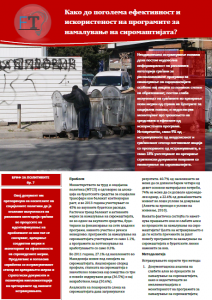
(1)Policy brief: “How to increase the effectiveness and utilization of the programs for poverty reduction?”

Response by the Ministry of Labor and Social Policy

Mini-interview for the national bi-lingual Alsat-M

Thematic Graphometrix

Article in the magazine Face in Face


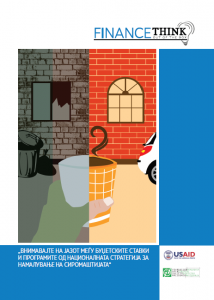
Booklet: Mind the gaps between the budget lines and the programs of the National Strategy for Poverty Reduction MKD version – ALB version

Thematic web site: www.siromastija.mk


Migration as social protection: Analysis of Macedonian, Albanian and Serbian remittance-receiving households

The objective of the research is to investigate if remittances sent to Macedonia, Albania and Serbia serve social protection for household members left behind.

In particular, we will analyse if and how remittances determine/influence social condition (stability or vulnerability) of the household, the latter being described through an index composition of the income level, employment status, nourishment, health and housing conditions. For the purpose of the study, we aim at defining social stability/vulnerability not in traditional terms – only as “dollar a day” – but rather in terms of household’s ability to meet their basic needs aside income: nutrition, health services, housing, leisure and the like. This touches upon Green’s (2014) recent note that “being poor and sick is very different from being poor and healthy” and defines social stability in this multidimensional framework.

The key tasks include:

  • developing a literature overview linking remittances to social protection and social vulnerability;
  • devising an indicator of social vulnerability;
  • econometric investigation of the causal links between remittances and social vulnerability;
  • deeper qualitative investigation through interviews of the linkages between and contexts of the two phenomena (remittances and social vulnerability);
  • devising policy proposals;
  • wide communication with the policymakers and the public.


Donor: Regional Research Promotion Program

Duration: 2 years (2014-2016)


***

Project meeting, Rome 2-5 April 2015 – Agenda – Gallery

Media appearance – Ekonomski horizonti – RevolucionerMK

RRPP Annual conference presentation, Ohrid 28-29 May 2015 – Resources

Round table, 10 June 2015 – Invitation – Agenda – Gallery – Presentation

International Conference on Eurasian Economies, 9-11 September 2015, Kazan Russia – Presentation – Proceedings

Training & Project meeting, Amsterdam 16-20 March 2016 – Agenda – Gallery 1 2

Workshop “Migration and its Consequences for Albanian Households”, Elbasan, Albania, 8 September 2016 – Agenda

EBES International Conference, Vienna, Austria, 28-30 September 2016 – Picture

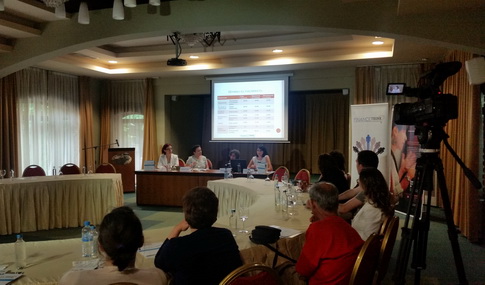
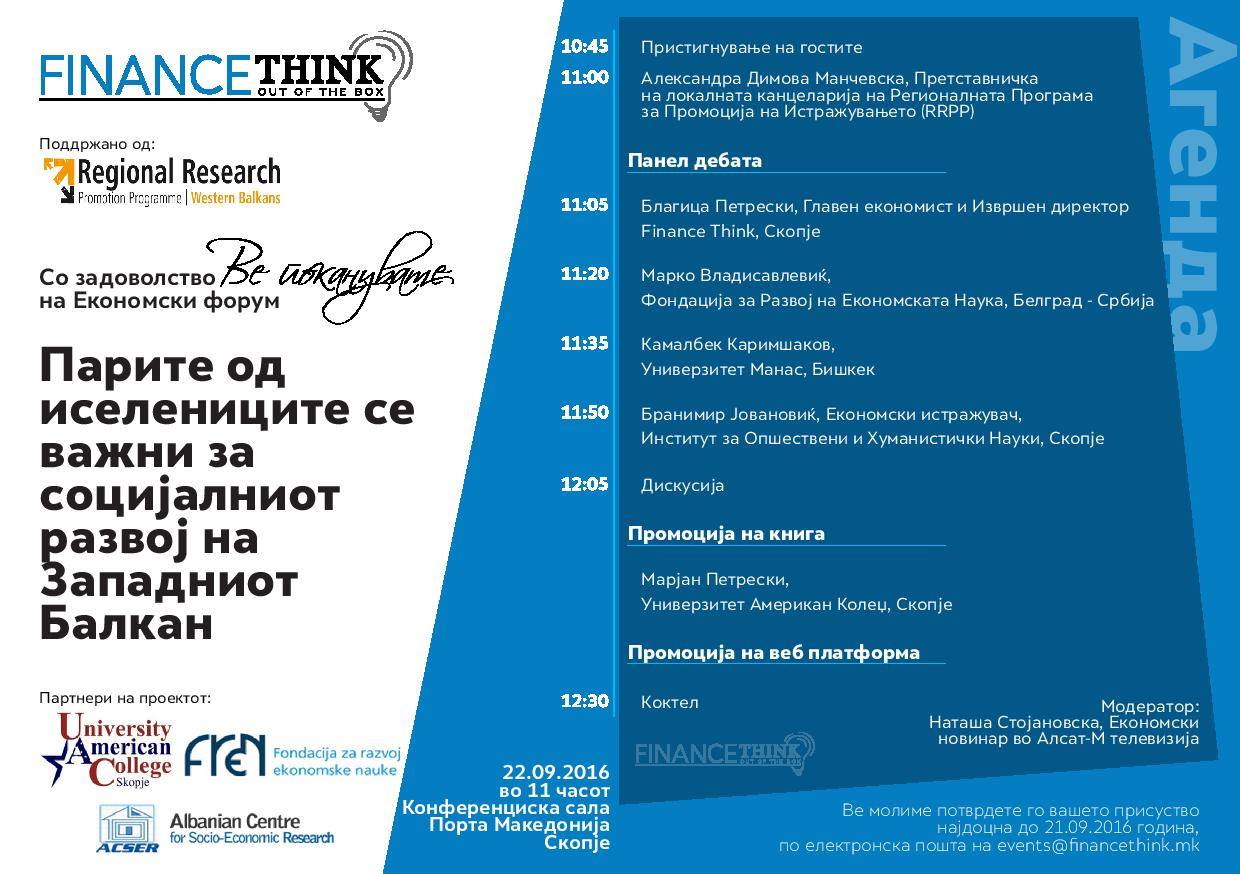
Economic forum, Skopje, 22 September 2016 – Agenda – Gallery


***

Policy briefs – Macedonia – Albania – Serbia

International book “Migration as social protection”

Journal article in International Migration
 

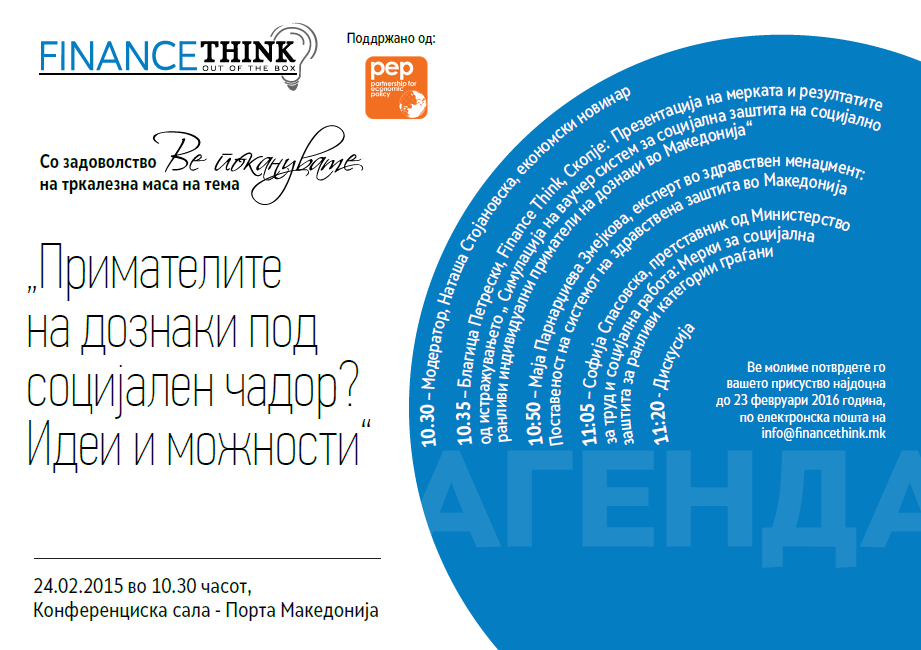
Simulation of a voucher policy for improving the social condition of individual remittance receivers in Macedonia

The purpose of the study is to develop a simulation of potential voucher system for social protection of individual members of the households receiving remittances in Macedonia.

Specific objectives:

– To conduct analysis for Macedonia at the individual level (using the DotM Remittance Survey 2008)

– To develop an econometric model;

– To simulate the effects of potential voucher for protection of socially vulnerable individual recipients of remittances by simulating the effects on the health indicator of the recipient.


Donor: Partnership for Economic Policies

Duration: 2014-2015 (1 year)


***

Policy brief – ENG – MK

Working paper

Policy conference – Invitation – Gallery

Journal paper


Economic Research Today for Better Policy Tomorrow

The оverall objective of this project is to build up the capacity of the Association for economic research, advocacy and policymaking “Finance Think” in supporting the economic policy decision makers to deliver credible policy decisions based on research findings and arguments based on quantification, as well in elevating the debate in the society about economic processes and reforms.


Provider: Think Tank Fund (Open Society Foundations)

Duration: 1 year (2014-2015)


Empowering women in Krushevo through mini clastering for sales and promotion of traditional products

Тhe objective of the project is to improve the living standards and social inclusion, and to reduce poverty in Krusevo, through association (mini-clustering) of women for production and sale of local, domestic, traditional and ecological, home-made products.
The short-term goals include:

Prompting social inclusion and interaction through association of individual producers, unemployed housewives;
Promoting awareness for investing in their skills to pull out of poverty and improve their lives;
Establishing system for production and promotion of local home-made products, in order to encourage and increase production, sales and promotion;
Strengthening the awareness among policy makers for the need of mini-clustering of individual producers of traditional food, as a tool to promote local economic growth and improve socio-economic conditions.


Donor: The Embassy of USA in Skopje

Duration: 2014-2015 (12 months)


Call for participants

Application for participation

Training for production, marketing and sales skills – Gallery 1 – Gallery 2 – Gallery 3

New Year Bazaar “Craft Art Fest” Participation – Gallery

Fair “It’s homemade, it’s from Krushevo…” – Gallery